
Guide
When reading is hard
Reading difficulty is easy to miss, because the things a struggling reader does to cope often look like something else. Here is what I actually watch for, why it happens, and the small changes that make the biggest difference.
What it looks like
Reluctance to read aloud
If you ask for volunteers to read in class and someone buries their head, or goes quiet, or suddenly needs the toilet, that is worth noticing. Most people avoid the thing they find hardest, and children are no different.
Tracking with a finger or a ruler
Using a finger to follow the line, or holding a ruler under the text, is not immaturity. It is a sensible strategy for keeping your place, and it usually means keeping your place is genuinely difficult.
Mouthing the words
I do this myself. You will watch me mouthing words as I read, because sub-vocalising helps me slow down and make sense of it. For me it is about remembering where I am in the line. My working memory is shocking, and that is one of the things that makes reading tricky.
Taking a very long time
Not inaccuracy, just slowness. A child who reads accurately but at half the pace of their classmates is working far harder than anyone realises, and will be exhausted by the end of a page.
Trouble blending sounds
If phonological processing is a bit wobbly, putting all the sounds together, or breaking them back down, does not come easily. That is the underlying skill most closely tied to dyslexia.
Unfamiliarity with the words themselves
If reading has been a chore for years, a child simply meets fewer words than their peers. The gap widens quietly, and it is a consequence of the difficulty rather than a cause of it.
What helps
Give them space on the page
Do not hand someone great bunched-up blocks of text. Generous line spacing and wider margins are the single most pragmatic change you can make, and they cost nothing. It sounds trivial. It is not.
Let them keep their place however they like
Fingers, rulers, a card under the line, a coloured overlay if it helps. None of these are things to be grown out of. They are tools.
Separate decoding from understanding
If you want to know whether a child understood a text, do not make reading it the barrier. Read it to them, or let them listen to it, and ask about the content. You will often find comprehension was never the problem.
Do not make reading aloud a performance
Reading round the class puts the least fluent reader in front of an audience at their worst moment. Paired reading, or reading to an adult quietly, gets the same practice without the humiliation.
Build the phonics foundation properly
For primary-aged children who find reading tricky, structured phonics work that follows the government programme is worth doing thoroughly rather than quickly. There are good free resources following those phases.
Why this happens
Reading looks like one skill but it is several running at once: recognising letter patterns, turning them into sounds, holding those sounds in order long enough to blend them, and then holding the resulting sentence in mind long enough to understand it.
Working memory carries a lot of that load. If it is unreliable, the sentence falls apart before it is finished, and you go back to the start of the line. That is exhausting, and it is why a slow reader is often a tired reader rather than a lazy one.
For teachers
The classroom changes that help most are the boring ones: spacing, not reading round the class, giving processing time after a question, and never assuming that a child who cannot read a text has not understood the idea in it.
Durrington Research School has genuinely good material on literacy in secondary settings, and the work they do is worth your time.
For parents
You do not need to become a reading teacher. What helps at home is keeping reading pleasant: reading to them well past the age you think you should stop, letting audiobooks count, and not turning the nightly reading record into a battle.
If the difficulty is persistent, and particularly if there is a gap between how articulate your child is out loud and what they manage on the page, that is the point at which a proper assessment answers the question rather than guessing at it.
This guide grew out of episode 2 ofThe Elevator Series, where you can watch me talk it through in about two minutes.
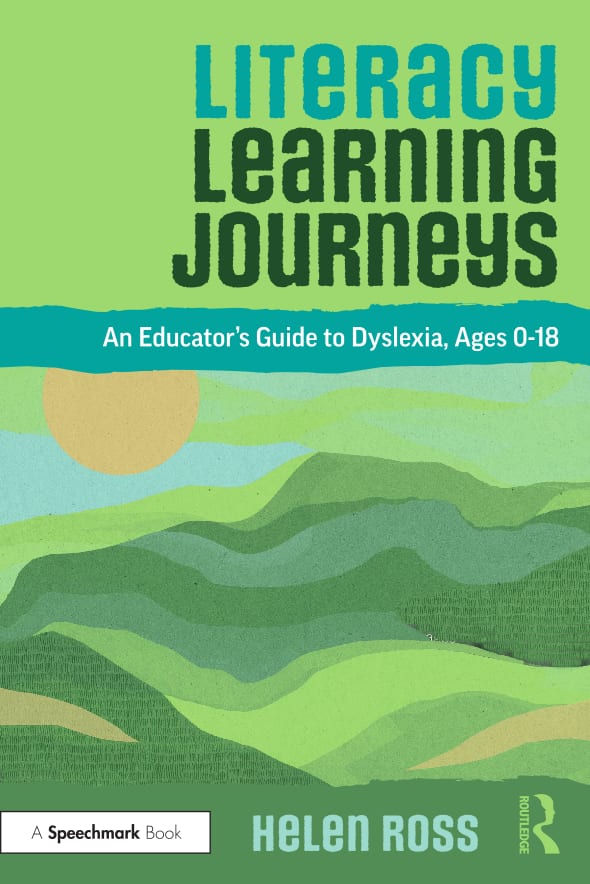
The book
There is a whole book of this.
Literacy Learning Journeys is a practical guide to supporting dyslexic children from Early Years to age 18, with evidence-based strategies, real case studies and reflection prompts. Published by Routledge.
Read more about the bookWondering whether to get an assessment?
Book a free 20-minute call and tell me what you have noticed. I will tell you honestly whether an assessment is the right next step.