
Guide
Knowing what goes first
Organising a task and knowing where to start is hard for anybody. Add the in-built wobbles that come with dyslexia or another specific learning difficulty, around organising work, planning, and finding a way into the task, and it becomes a genuine barrier. I find it tricky myself, and my colleagues deal with the consequences.
What it looks like
A long pause before anything happens
Sitting with a blank page while everyone else is writing. Often read as daydreaming or avoidance, when it is actually someone trying to work out where the entrance is.
The first sentence is the worst part
What is really hard for a lot of dyslexic people is that first sentence. Starting sentences can be a nightmare. Once the first one exists, the rest usually follows far more easily.
Knowing the content but not the order
Having plenty of ideas and no sense of which comes first. The material is there. The sequence is not.
Repeated restarting
Writing a line, crossing it out, starting again. Each restart costs energy, and after a few the task feels impossible rather than just hard.
What helps
Mind map before writing
A mind map is such a helpful tool because it lets someone visualise what they are doing and see how to chunk it down. It turns an unordered pile of ideas into something with a shape, which is exactly what is missing.
Provide sentence starters
If you are an educator, have sentences and paragraph openers up around your room, or on a prompt sheet students can use while working through a task. It just makes it so much easier. That way in is the whole problem, so handing it over solves most of it.
Let them talk it first
Text to speech is brilliant if it is available. So is simply saying the first sentence out loud to someone before writing it. Speech is usually the strongest channel, so use it to get the writing started.
Typing instead of handwriting
Being able to type rather than physically write takes a real burden off, and makes reordering afterwards trivial rather than a rewrite.
Chunk the task explicitly
Do not say write an essay. Say write three bullet points about the first idea. A task that is visibly finishable gets started.
Accept a bad first sentence
Give explicit permission to write a rubbish opening on the understanding it will be changed. Most of the paralysis is about getting it right first time.
Why it happens
Starting requires you to hold the whole task in mind, decide on an order, choose an entry point, and begin, all at once. That leans heavily on working memory and executive function, which are exactly the areas most often affected.
This is why the advice to just get started is useless. The starting is the difficult part, not a preliminary to it.
For teachers
Sentence starters and paragraph openers on the wall cost you one afternoon and help every learner in the room, not just the dyslexic ones.
Watch for the student who has not written anything twelve minutes in. That is not defiance, and asking what they are stuck on will usually get a precise answer.
Nessy has good material on working memory aimed at Key Stage 2 and 3, which covers a lot of the ground underneath this.
For parents
Homework paralysis is worth naming out loud. Sitting with someone for the first two minutes, helping them say the first sentence, and then leaving them to it, is often the whole intervention.
If starting is a daily battle across every subject, that pattern is worth mentioning when you talk to school, or to an assessor.
This guide grew out of episode 6 ofThe Elevator Series, where you can watch me talk it through in about two minutes.
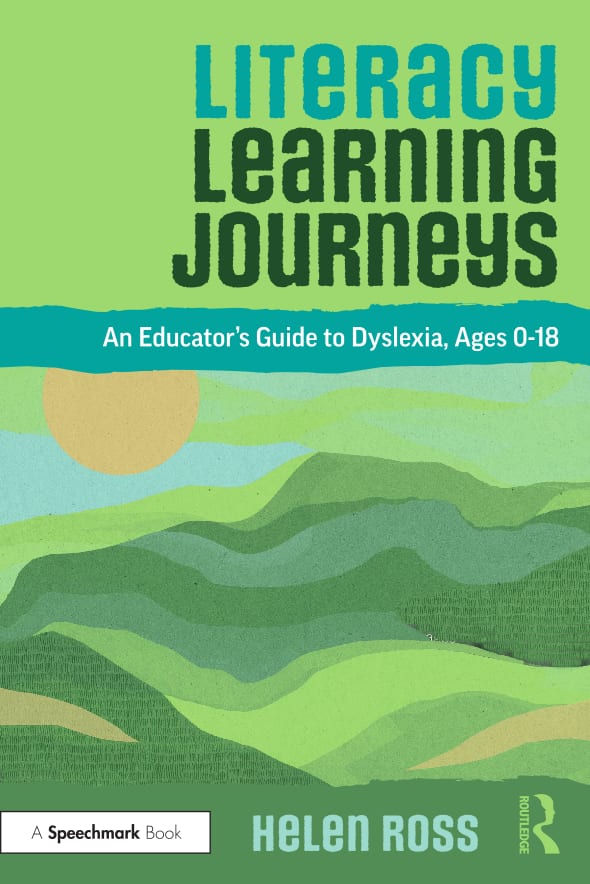
The book
There is a whole book of this.
Literacy Learning Journeys is a practical guide to supporting dyslexic children from Early Years to age 18, with evidence-based strategies, real case studies and reflection prompts. Published by Routledge.
Read more about the bookWondering whether to get an assessment?
Book a free 20-minute call and tell me what you have noticed. I will tell you honestly whether an assessment is the right next step.